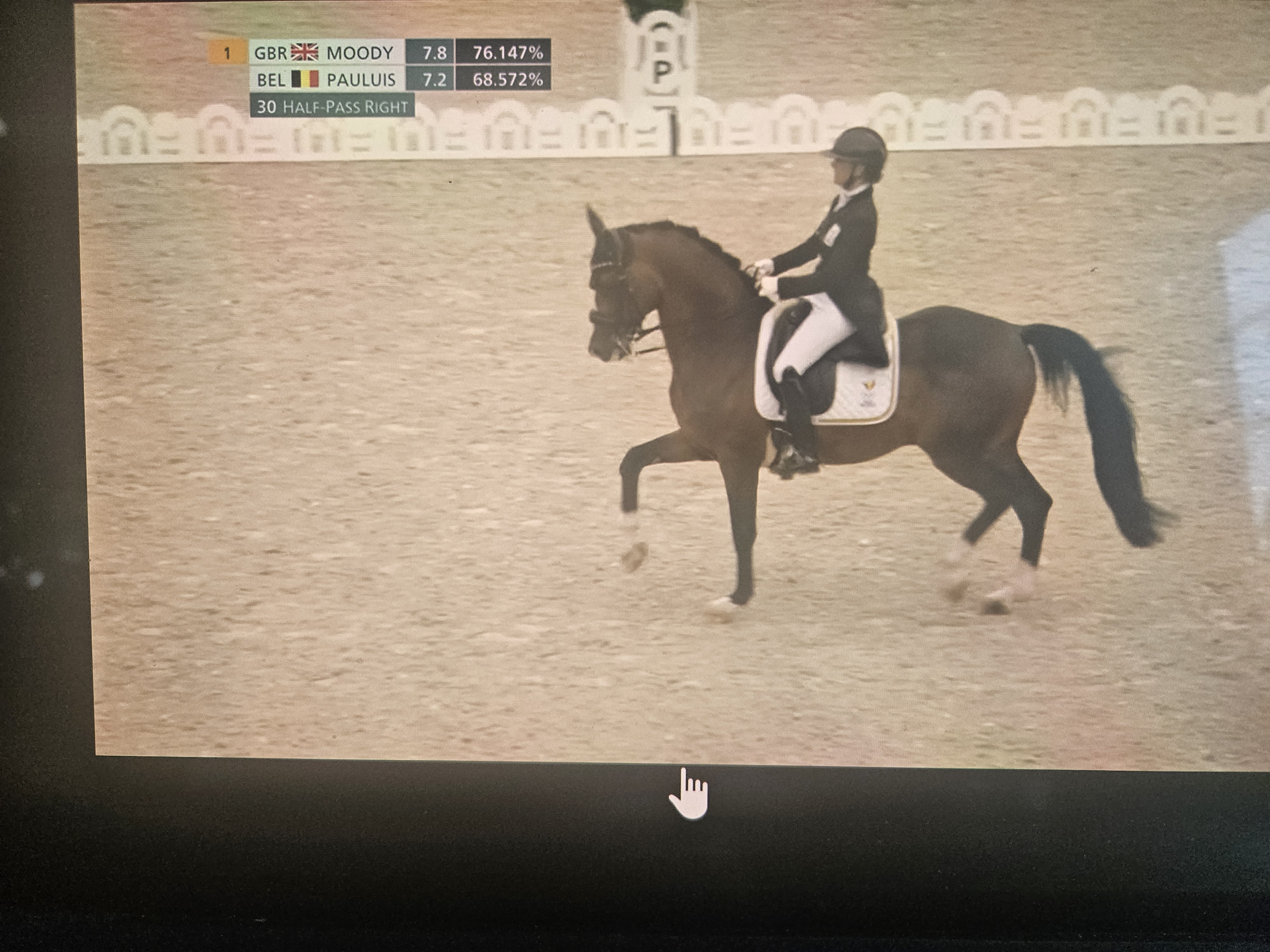
I was up at 4am to watch live the dressage in Paris. It was was worth it but I only did that once as I found I could see all the rides later as there were replays. There were two commentators who were excellent.The man gave us lots of technical details, such as how to read the scores that appeared on the top left of the screen. I will explain that now so you can understand it when you see it in my photos. The rider currently in the ring is lower name and the horse and rider with the leading score are at the top . Below them are the last movement of the test and also the number that the judges gave for that movement. An 8 is “Very” Good” a 7 is quite good and below it not so good. A 10 is extremely good. I never saw a 10 for anyone in The Paris Olympics!!Here is a photo with the information at the top left .This photo is of the Belgian rider Laurissa Palius on Flambeau .All of the photos are just photos I took on my phone of the computer screen so not up to a good standard !!You may need to click on them to see them more clearly.

This is a photo below of Becky Moody and her final score in the GP Becky rode in her first Olympics for Team Great Britain. Becky was also the reserve rider for Team ‘GB’. She would have been called in after the Charlotte Dujardin debacle. Becky is only 21 years old and I was impressed with how well she did.And below that photo is Carl Hester and his GP score


The Canadians did well in their rides but did not get high scores. This was to be expected. Dressage is a sport where the judges know the competitors in advance an eI think they know what they should give them in terms of scores.. Here is Chris von Martel’s final score.


I watched all of the Canadian rides and took some photos of them.


Above is Naima riding a half pass. The scope of Statesman’s movement is so good. But as you can see the judges are not really rewarding it.

The male commentator told us that the jumbotrons at the end of the arena were not following the riders as it was decided the this would interfere with the rider’s concentration and also might spook the horses. A very wise decision I thought. But is this not a spectacular venue for dressage?

Above it’s Camille Bergeron and her mare Finlanderin in piaffe. The photo makes the mare look dark but she is, in fact, a chestnut mare.

Above is the Queenof dressage Isabel Werth.She is riding Wendy, a horse she has only ridden for a few months. Lucinda told us the Isabel has the ability to sit on a horse and know immediatly if she will be able to ride the horse sucessfully. Lucinda who is a well known journalist and rider also told us that all of the horses we were seeing were “Athletes, Gymnasts and ballet dancers” She is right . They all are combinations of those things .Especially horses who are in the Olympics! She also said that the most important thing between horse and rider was trust and confidence. This is another basic truth about riding at any level not just the Olympics.

The photo above is of Larissa Pauluis of Belgium. She showed us what is written on her gloves after she finished her ride. The CBC annoucer told us this was in honor of her late husband who died in 2020. She also wore these gloves when she rode in the Tokyo Olympics. The announcer told us she had promised him she would be an Olympic rider.

At the end of the day these are the Team standings. The Grand Prix Special will decide who will win the Team medals.
Second day of the dressage. I did not get up at 4 am because I knew that I would see it on the replay broadcast on CBC Gem. At the end of the second day Here are the standings.

I think Canada’s riders will not be upset by this.They knew coming in that they would not be in the medals. Still their rides were without big errors and were good rides!

This is Isabel Werth and her final Grand Prix score. There are many times in her career she has scored well over 80%! Below is a photo of Isabel in her GP Special ride.


This photo shows the stadings at the end of the GP Special. No surprises there. The final day was the freestyles. For the Freestyles the rider can choose the movements and the order they are executed. This allows the rider to choose the movemenrts that will show the horse to its best and show the movements it excells in. One of the imporant aspects of the freestyle is the degree of difficulty. If the horse and rider execute a movmement with high degree of difficulty the score will be boosted. One example is an extended canter into a pirouette. I saw several of these and not just single pirouettes but double pirouettes. Also doing two tempis to one tempis is also a high degree of diffculty .The horse will not be expecting this change from changes every two strides to changes every stride. I watched Carl Hester’s freestyle and Isabel’s.

Isabel
Isabel’s freestyle was very good with several movements having a high degree of difficulty. CArl also had several movements with a high degree pf difficulty. He seemed very happy with how his test had gone after his final salute


His British fans ageed! I wathced several of the freestyles. This one with Netherlands rider Dinja van Liere was also very good.


These flags show the final medal results Germany in first place, Denmark in second, and Great Britain in third.

I am cannot edit this photo so please excuse the keyboard of my PC in so much of this photo. These are the three medal winners after their medal presentations. Their horses and grooms are in the background.

This is a less distracting photo taken before the medals were presented. . Thanks for reading . That is all I can tell you about the Olympic dressage.


Leave a Reply to anne leueenCancel reply